Software Development
The Quiet Rise of a Full-Stack Developer: A Journey Through Code, Curiosity & Coffee
Vishal Yadav• 17 Nov 2025
Software Development
Some careers don’t begin with dramatic moments. Sometimes it’s just a late night, a laptop running a little too hot, and a curious mind poking at a bug that refuses to die.
That’s pretty much how Rupesh’s journey started.Managed IT Services
He didn’t grow up dreaming of being a “Full-Stack Developer.” Honestly, he didn’t even know what that meant until his second year of college. Top Web Development Companies But he did enjoy building things—tiny, scrappy little projects that worked half the time and crashed the other half. And he loved that feeling of watching something come alive on screen because of lines he typed.
Like many developers, Rupesh first dipped his toes into frontend work. HTML felt silly-easy. CSS felt oddly satisfying. JavaScript felt like a puzzle that judged him quietly every time he forgot a semicolon.
He built landing pages, dashboards, a portfolio site he never finished (because, of course), and little experiments where he tried animations, dark mode toggles, and whatever trend Twitter was screaming about.IT Services Company
There was this one moment though — he remembers it vividly — when he fetched data from an API for the first time. Watching that JSON render as actual UI? It felt like power. Real power.
That’s when he realized:
Frontend is fun… but where does all this data actually come from?
Curiosity is a dangerous thing in tech. It makes people open doors they’re not prepared to walk through.Top IT Services Companies
That’s how Rupesh ended up learning Node.js.
The backend felt like a different universe: databases, schemas, environment variables, JWT tokens, middleware — it was messy, complex, oddly intimidating… but also kind of beautiful. It was like seeing the wiring behind a building for the first time.
He loved the structure. The clarity. The control.
He built his first API in a weekend.
It was terrible.
It worked.
He was proud.
Then came databases. MongoDB became his friend — mostly because SQL scared him at first. He eventually learned that SQL wasn’t a monster, just a strict parent with too many rules.
There’s this moment every developer goes through — that day when you realize:
“Wait… I can build the whole thing myself.”
For Rupesh, that moment came during a freelance project where he had to build a complete booking system — UI, backend, database, authentication, email notifications, everything.
He spent nights designing UI components, mornings writing Express.js routes, afternoons fixing CORS errors he didn’t ask for, and evenings wondering why deployment feels like a horror game.
But when it finally worked — when a real user actually signed up on something he built end-to-end — the feeling was unreal.
That’s when the identity clicked:
He wasn’t “frontend” or “backend” anymore.
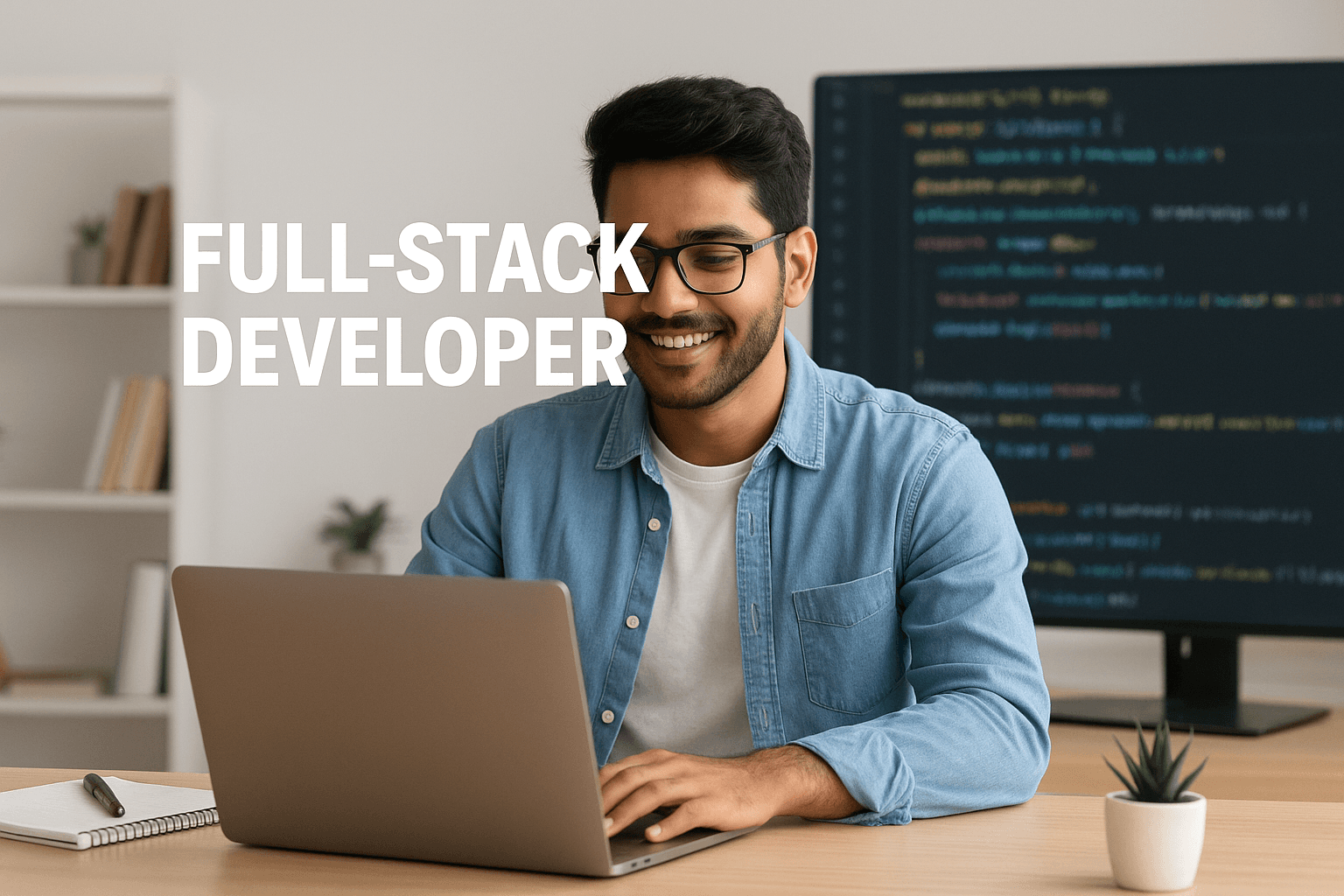
He was full-stack.
His day wasn’t perfect. No full-stack developer’s day is.
Some mornings started with broken builds.
Some nights ended with him googling “why does this work in console but not in code.”
Sometimes everything just stopped working because he missed a comma.
But full-stack development isn’t about perfection. It’s about resilience, adaptability, and the ability to jump between worlds — UI styling one minute, database indexing the next.
And weirdly, he loved that chaos.
Today, Rupesh works as a full-stack developer at a mid-size product company, building things people actually use. Real users. Real impact. Real feedback — good and bad.
He uses React and Next.js on the frontend, Node.js and MongoDB on the backend.
Some days he mentors juniors.
Some days he fights AWS.
Some days he wonders if he should just become a farmer instead.
But every day, he learns something new — and that’s what keeps him going.
Rupesh's story isn’t dramatic.
It’s not viral.
It’s not a movie script.
It’s just real.
A person who fell in love with building things…
… and kept walking — bug after bug, project after project — until one day he looked back and realized:
He’d become a full-stack developer.
We can help you launch fast, scale smart, and sell nonstop.

Check back later — new content will appear here once published.